
LOAD&GO.
Digitising heavy haulage operations to reduce friction, risk, and lost time.
This project began with a simple realisation: most of the complexity in heavy haulage operations lies outside the truck.
Before a driver even starts the engine, they are already managing safety checks, compliance records, job documentation, and approvals. Throughout the day, they collect signatures, record deliveries, log breaks, and coordinate changes over the radio. At the end of each shift, everything has to be reconciled and returned to the office. Any missing documents, unclear records, or late deliveries can become costly issues for both the driver and the business.
Load & Go existed in this world of legacy processes, carbon-copy books, physical dockets, handwritten logs, and fragmented systems. The product challenge was not simply to “digitise paperwork”, but to reduce the operational burden created by this fragmentation while preserving trust, compliance, and accountability.
The Challenge
Heavy haulage businesses operate in environments where timing, safety, and documentation are tightly regulated. When I began working with Load & Go, much of this work was still managed manually. Drivers collected physical job sheets from the office, completed written safety inspections before departure, gathered signatures and receipts at delivery sites, and recorded breaks and delays by hand. Each delivery generated a new set of records, and each record had to be checked, filed, and stored.
Drivers often completed three or four runs per day, which meant repeating the process multiple times under time pressure. When traffic, road closures, or loading delays occurred, coordination relied heavily on radio communication and informal updates. Small disruptions compounded quickly, increasing the risk of missed documentation, compliance breaches, and financial penalties.
Most of the friction in the system did not come from driving itself. It came from managing information that was spread across notebooks, folders, offices, radios, and memory.
My Role
I worked as the lead product designer on the project, responsible for shaping the end-to-end experience across driver, depot, and operations workflows. This included conducting field research, mapping operational journeys, translating complex physical processes into digital systems, and working closely with engineering and business stakeholders to ensure feasibility and adoption.
The engagement ran from early concept through to production, with the system ultimately implemented and used in live operations.
Understanding the Reality on the Ground
Rather than starting with assumptions, we began by spending time with the owner and drivers to understand how work actually happened day to day. We walked through a typical shift from early morning setup to end-of-day reconciliation, observing where effort was being spent and where risk accumulated.
Before leaving the depot, drivers were required to complete full safety inspections and record compliance checks in physical logbooks. These inspections were formally signed off before any vehicle could leave. Once approved, drivers collected physical dockets from the office and began their routes. At each site, they handed over paperwork, obtained signatures, collected receipts, and recorded details again in daily logs. Long-distance drivers also had to schedule and record breaks to meet health and safety regulations.
Throughout the day, unexpected issues such as traffic, road closures, and late loads were managed through radio communication and ad hoc coordination. Each disruption required manual adjustments and additional documentation. By the end of the shift, drivers returned with folders of paperwork that needed to be checked, reconciled, and filed.
Seeing this process firsthand made it clear that the core challenge was not a lack of discipline or professionalism. It was the cognitive and administrative burden imposed by fragmented systems that forced people to constantly reconstruct context to stay compliant.
Approach
Our design approach began with mapping the full operational journey from morning checks to final reconciliation, identifying points of duplication, manual handling, and unnecessary movement between systems. Rather than replicating existing forms digitally, we focused on understanding why each record existed and how it was used downstream.
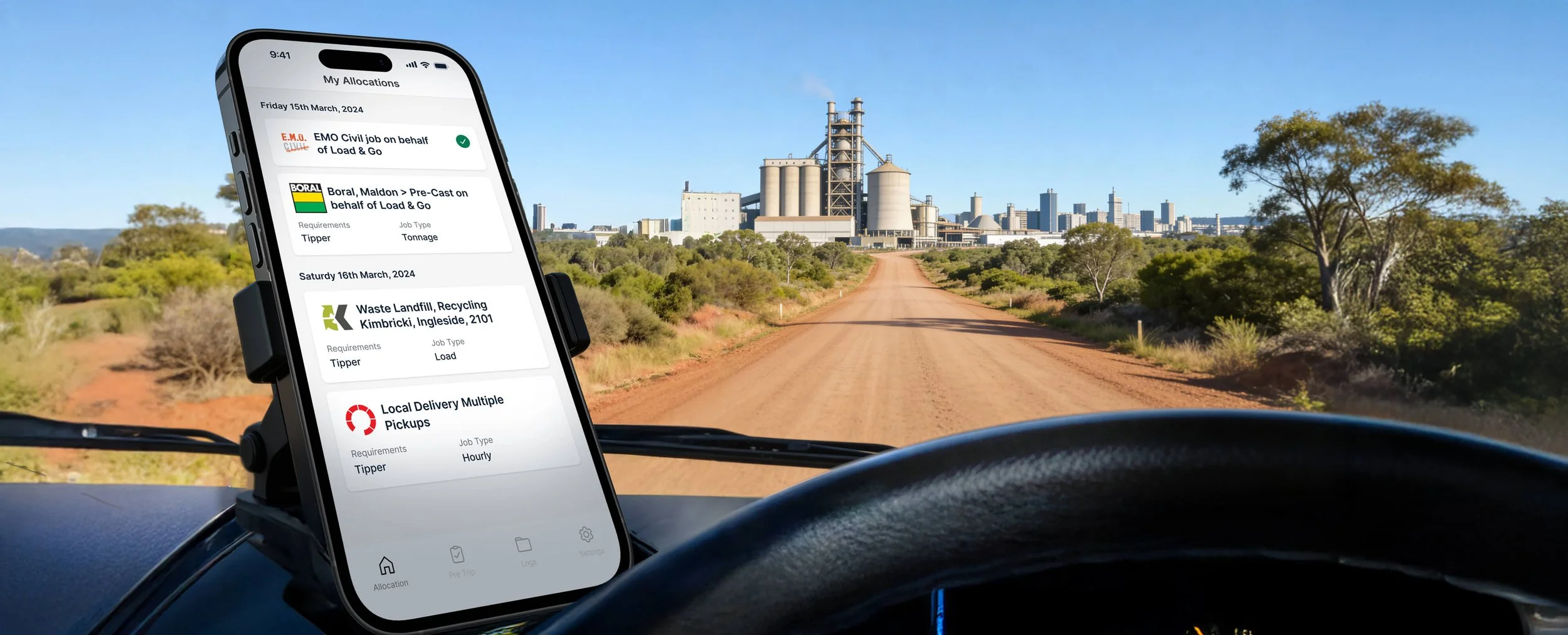
From this foundation, we designed a mobile experience that allowed drivers to receive jobs digitally, complete safety inspections on their devices, capture signatures and receipts in context, and store supporting documentation as photos. GPS-based tracking enabled real-time visibility of delays, incidents, and route changes, reducing reliance on radio communication alone.
Alongside the driver experience, we designed a backend platform that ingested operational data, maintained audit trails, and connected workflows to existing databases. This enabled central oversight without introducing additional administrative burden.
Throughout the process, concepts were tested and refined with users to ensure the system reflected real working conditions rather than idealised workflows.
Outcomes
The introduction of a unified digital workflow reduced reliance on paper-based processes and minimised unnecessary movement between drivers, depot staff, and office systems. Morning dispatch became faster and more predictable. Documentation errors and missing records decreased. End-of-day reconciliation became significantly simpler, and compliance processes became embedded into daily routines rather than treated as separate tasks.
Drivers spent less time managing paperwork and more time focusing on deliveries. Operations staff gained clearer visibility of activity, delays, and risks. The platform was taken through to production and remains in active use within the business.
More importantly, the system became easier to trust. People no longer had to stitch together information from multiple sources in order to understand what was happening.
Reflection
This project reinforced that many of the most important design problems are coordination problems rather than interface problems. In operational environments, usability is defined by the mental and physical effort required to stay aligned, compliant, and confident in their decisions.
If users are required to assemble context from multiple systems before they can act, the product has already failed them, regardless of how polished it appears. Load & Go shaped how I now approach complex systems across logistics, finance, and healthcare, focusing less on surface-level optimisation and more on reducing invisible friction.
Good design in these contexts is not about visual refinement. It is about supporting better judgment, reducing risk, and creating systems people can rely on under pressure.
“Jon consistently challenged assumptions in constructive ways, keeping the user perspective central while grounding decisions in real-world constraints. His depth of expertise and collaborative approach lifted the quality of complex digital products.”
— Head of Strategy and AI, 4Mation Technologies